


 By
By - A Bitcoin call option gives you the right to buy BTC at a set price before expiry. A put gives you the right to sell. You pay a “premium” upfront — and that premium is the maximum you can lose.
- “Max pain” is the strike price where the most contracts expire worthless — on March 28, 2026, that number was $75,000 while BTC sat near $71,000, creating a measurable gravitational pull toward that level.
- The four Greeks (Delta, Gamma, Vega, Theta) tell you how an option’s price moves with the market. Understanding them is the difference between accidentally losing money and deliberately managing risk.
- Deribit handles roughly 90% of all Bitcoin and Ethereum options volume globally — if you want to trade or even just read crypto options data, this is the exchange you need to understand.
Every Friday, traders post things like “$14B Bitcoin options expiry” and “$75K max pain” all over crypto Twitter. Most people scroll past it.
That is a mistake. The options market is now the single most accurate leading indicator of where professional money is positioned on Bitcoin. Bitcoin options trading is no longer a niche topic for derivatives desks — it is fundamental context for every serious crypto investor. Here is everything you need to understand it, from the very first concept to reading Deribit’s live data.
Start Here: What a Bitcoin Option Actually Is
An option is a contract that gives you the right — but not the obligation — to buy or sell Bitcoin at a specific price, on or before a specific date. You pay a fee upfront called the “premium.” That premium is the most money you can lose on the trade, no matter what happens.

Think of it like this: you think Bitcoin is going to $100,000 within 3 months. You could buy actual Bitcoin and risk your full position if you are wrong. Or you could buy a call option at a $90,000 strike price, pay a $1,500 premium, and have the right to buy BTC at $90K anytime before the expiry date.
If BTC hits $95,000, you exercise the option and pocket the spread. If BTC drops to $60,000, you lose only the $1,500 premium — not the full position. The option caps your downside while keeping your upside open.
Calls vs Puts: The Two Directions

There are only two types of options. Everything else builds on this.
Call options are bullish bets. When you buy a call, you have the right to buy Bitcoin at the strike price. You buy calls when you expect the price to go up. If it does not reach your strike by expiry, the option expires worthless and you lose only the premium.
Put options are bearish bets. When you buy a put, you have the right to sell Bitcoin at the strike price. You buy puts when you expect the price to go down. If BTC falls below your strike, your put becomes profitable. Puts are also commonly used as insurance — a hedge on a Bitcoin position you are holding in case the price drops sharply.
📊 Real example: March 28, 2026 expiry
Put/call ratio: 0.63 — for every 63 puts (bearish), there were 100 calls (bullish). Spot price at settlement: ~$71,000. Max pain: $75,000. Total notional: $14.16 billion. Outcome: majority of call buyers lost their premium because BTC settled well below the popular call strikes.
The Four Greeks: What Moves an Option’s Price
Options do not move in a straight line with Bitcoin’s price. Their value changes based on four variables, collectively called “the Greeks.” You do not need to calculate them yourself — Deribit shows them in real time — but you need to understand what they mean.
| Greek | What It Measures | Plain English | Example |
|---|---|---|---|
| Delta (Δ) | Price sensitivity | How much the option moves per $1 move in BTC | Delta 0.5 = option gains $0.50 per $1 BTC rise |
| Gamma (Γ) | Rate of delta change | How fast delta accelerates as BTC moves | High gamma near expiry = explosive moves on breakout |
| Vega (ν) | Volatility sensitivity | How much the option gains when expected volatility rises | High vega options get expensive before major events |
| Theta (θ) | Time decay | How much value the option loses each day | Theta -$50 = option loses $50 of value per day |
The most important Greek for beginners is Theta. Options lose value every single day they are not exercised, called “time decay.” If you buy a call that is far out of the money with a month left until expiry, theta is eating your premium every day even if Bitcoin stays flat.
Most retail option buyers lose money not because BTC moves the wrong way, but because they underestimate how fast theta destroys value.
🚨 TODAY: Nearly $13B in Bitcoin options set to expire today on Deribit.
— Cointelegraph (@Cointelegraph) March 28, 2026
Max Pain: Why Bitcoin Often Drifts Toward a Specific Price Before Expiry
Max pain is the strike price at which the total value of all expiring options is minimised, the level where call buyers and put buyers together lose the most money.
It is calculated by summing the in-the-money value of all calls and puts at each possible expiry price and finding where the total payout to buyers is smallest.
Here is the key insight: the entities selling options (primarily market makers) are not passive. They hedge their exposure in the spot market to stay delta-neutral.
As an expiry approaches and open interest concentrates around certain strikes, those hedging flows can push the spot price of Bitcoin toward the max pain level. This is not market manipulation — it is natural hedging pressure from large, sophisticated market participants, all following rational incentives.
Research across quarterly Bitcoin expiries on Deribit shows that BTC settles within 5% of the max pain level roughly 60-65% of the time. It is not a sure thing, but it is a statistically significant signal that serious traders monitor weekly.
How to Read Deribit’s Options Chain
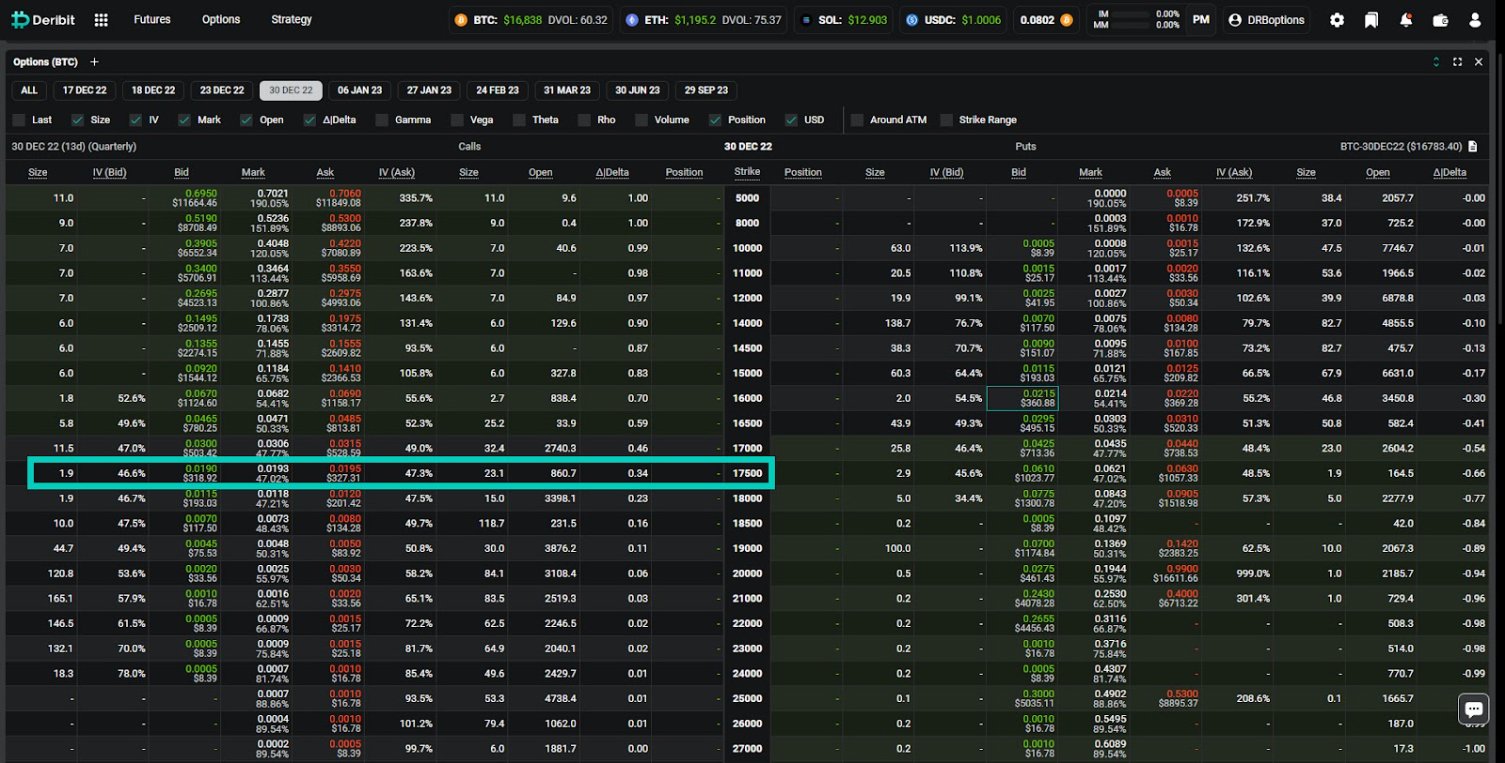
Deribit (deribit.com) controls roughly 90% of all Bitcoin and Ethereum options volume globally. Reading their options chain is simpler than it looks once you know the terminology.
Each row in the chain represents a specific strike price. The columns show you the bid and ask price for both calls (left side) and puts (right side) at that strike. The current BTC spot price sits in the middle of the chain, strikes above spot are “out of the money” calls and “in the money” puts; strikes below spot are “in the money” calls and “out of the money” puts.
Open Interest (OI) is the total number of active contracts at each strike. High OI at a specific strike means a lot of money is concentrated there, this is where max pain calculations get their weight.
The strikes with the most open interest are also where hedging flows will be largest as expiry approaches, making them magnetic price levels.
Understanding Implied Volatility (IV)
Implied volatility is the market’s consensus forecast of how much Bitcoin will move in a given period, expressed as an annualised percentage. When IV is high, options are expensive, the market expects big moves. When IV is low, options are cheap — the market expects calm.
IV typically spikes before major events (Bitcoin halving, Fed meetings, regulatory decisions) and compresses as expiry approaches with no dramatic move. The compression of IV near expiry is why options often get cheaper in the final days before settlement, a phenomenon called “IV crush.” Buying options right before expiry, hoping for a breakout, is one of the most common losing strategies in crypto options because you are buying into low IV with maximum theta drag.
📊 The $55 billion options market
Bitcoin’s options open interest has grown from under $5B in 2021 to over $55B in 2026. Quarterly expirations routinely clear $10-15B in a single morning settlement. This is now a major institutional market — the same mechanics that move equity options markets are fully operational in crypto.
The Difference Between Buying and Selling Options
Everything above describes buying options, paying a premium for the right to profit. Selling (writing) options flips the model: you collect the premium upfront and take on the obligation to deliver if the buyer exercises. Option sellers profit from time decay and IV compression. Option sellers can also lose far more than they collect if the market moves violently against them — a risk called being “short gamma.”
Most retail traders should focus on buying options (defined, limited risk) before ever selling uncovered options (theoretically unlimited risk). The professionals running large options books on Deribit are selling options and hedging continuously, which is exactly why understanding the hedging flows and max pain concept matters even for traders who never write a single contract.
🚨 TODAY: NEARLY $13B IN BITCOIN OPTIONS SET TO EXPIRE ON DERIBIT! #Bitcoin #Crypto #BTC #Deribit #OptionsExpiry #CryptoNews #CryptoTrading
— Crypto News Hunters (@CryptoNewsHntrs) March 28, 2026
TechToken Take
You do not need to trade options to benefit from understanding them. Even if you only ever buy and hold spot Bitcoin, reading the put/call ratio and open interest distribution on Deribit gives you real insight into where institutional money is positioned. When the put/call ratio is 0.6 and max pain is 6% above spot, sophisticated money is net-long and slightly wrong — that is useful information regardless of your trading style. The options market is the most honest place in crypto, because it costs money to be wrong.
Where to Go From Here
The best free tool for reading Bitcoin options data is the Deribit analytics page and their publicly available options chain at deribit.com. You do not need an account to view the live options chain, open interest charts, or max pain levels, it is all public data.
For deeper analysis, The Block and Glassnode both publish weekly options market summaries that track put/call ratios, IV term structure, and open interest changes.
As TechToken covers the Bitcoin market weekly, understanding these indicators will make every price analysis piece significantly more useful to you — because unlike social media sentiment or technical chart patterns, options positioning is backed by real money on the line.
Further reading: how Bitcoin works and CME Group.
What's your reaction?





[…] reading: Bitcoin options explained and Binance support […]